
Startup Funding

Search Startupfunding above or view our

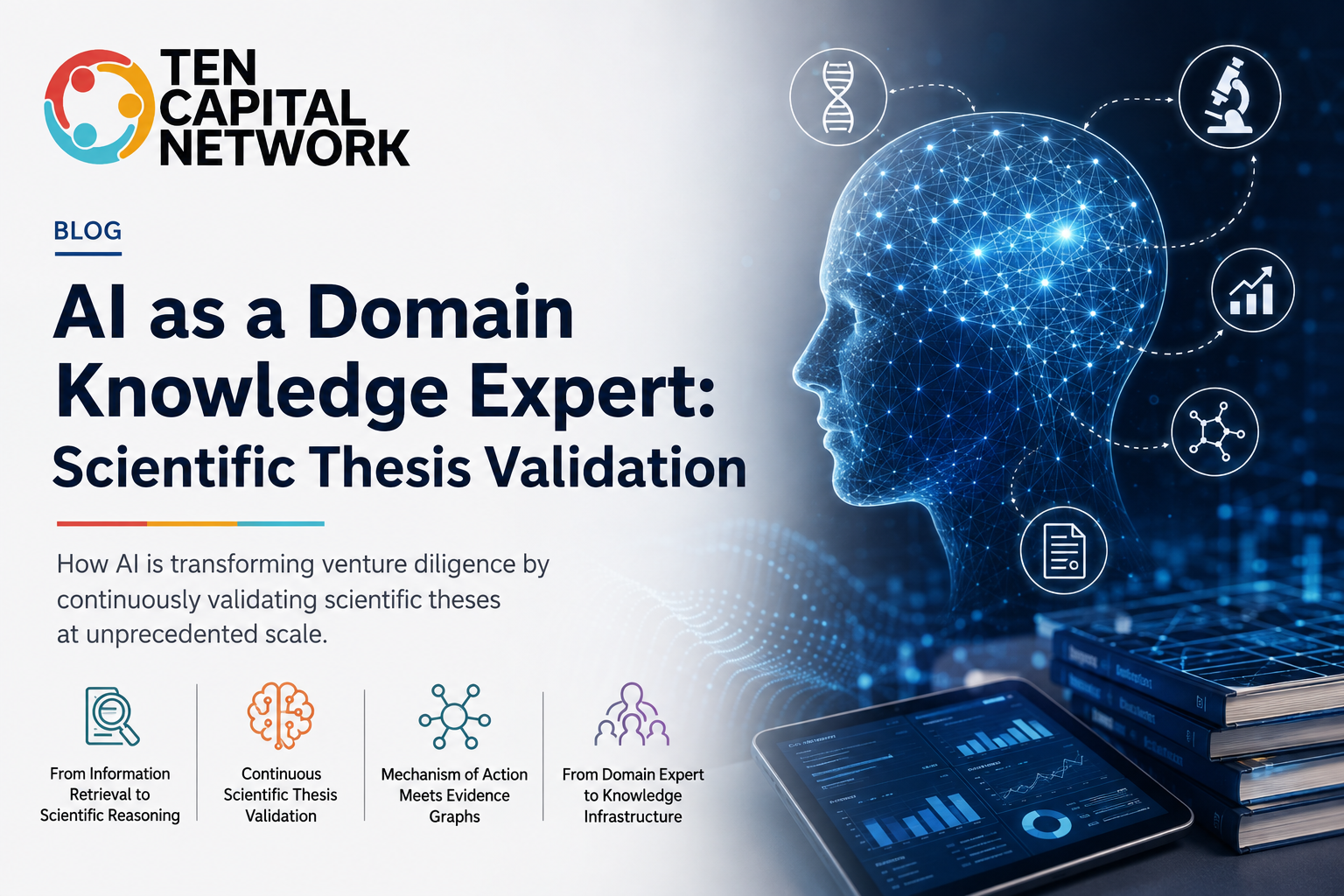
AI as a Domain Knowledge Expert: Scientific Thesis Validation

5 min read AI as a Domain Knowledge Expert: Scientific Thesis Validation For decades, deep technology investing has revolved around one fundamental constraint: knowledge. The most successful venture investors weren’t simply skilled financiers—they were domain experts. In biotechnology, advanced materials, semiconductors, aerospace, climate technology, and energy, the ability to understand complex science often determined whether investors backed the next breakthrough or missed it entirely. The challenge has never been finding opportunities. It has been determining which scientific ideas are actually correct. Artificial intelligence is changing that equation. While much attention has focused on AI as a productivity tool capable of generating reports, writing code, or summarizing research, a far more significant transformation is emerging. AI is rapidly becoming a domain knowledge expert capable of validating scientific hypotheses at a scale previously impossible for human teams. This represents one of the most important shifts in venture capital since the widespread adoption of online data services. From Information Retrieval to Scientific Reasoning Historically, validating a scientific thesis required assembling an expensive network of advisors. Venture firms hired former professors, physicians, regulatory specialists, and industry veterans to evaluate whether a startup’s underlying science was plausible. Each expert reviewed papers within their specialty. Each brought years of accumulated knowledge. But each also carried natural limitations. No individual scientist can read the millions of papers published annually across biomedical research, chemistry, molecular biology, engineering, and computational sciences. Human expertise remains deep—but necessarily narrow. AI changes this dynamic. Modern large language models coupled with scientific databases can simultaneously analyze thousands of journal articles, patents, conference proceedings, clinical trial records, FDA filings, regulatory guidance documents, and competitive intelligence reports. Rather than simply retrieving information, AI increasingly identifies relationships between discoveries that may have been published years apart across entirely different disciplines. The result is something closer to institutional scientific memory than simple search. Scientific Thesis Validation Becomes Continuous Every startup begins with a thesis. The founders believe they understand a problem better than everyone else. In biotechnology, that thesis might involve a disease pathway. In climate technology, it may involve a novel catalyst. In semiconductor design, it could be an architectural innovation. Investors ultimately ask one question: Is the underlying scientific thesis likely to be true? Previously, answering that question required weeks of diligence. Today, AI can evaluate supporting evidence almost instantly. It can compare competing hypotheses, identify contradictory findings, analyze reproducibility across studies, map biological pathways, review historical clinical outcomes, and identify analogous technologies that succeeded—or failed. Instead of asking whether a single paper supports an idea, AI asks whether the entire body of scientific literature supports it. That shift fundamentally changes venture diligence. From Domain Expert to Knowledge Infrastructure Traditional venture firms scaled by hiring experienced partners. Each new investment required additional human expertise. As portfolios expanded, so did the need for specialized consultants. AI introduces a different model. Instead of scaling people, firms scale knowledge infrastructure. Every investment benefits from continuously updated scientific reasoning built upon expanding global research. The knowledge base never retires. It never forgets prior diligence. It continuously incorporates newly published evidence. Human experts remain essential, but their role evolves. Instead of spending weeks collecting information, they spend their time interpreting evidence, questioning assumptions, and exercising judgment where uncertainty remains. AI performs synthesis. Humans perform skepticism. The combination is considerably more powerful than either operating alone. Mechanism of Action Meets Evidence Graphs One of the most difficult aspects of biotech investing has always been evaluating mechanism of action. Does the proposed therapy truly affect disease progression? Or does it simply influence a biomarker without improving patient outcomes? These questions require understanding complex biological systems. AI now builds evidence graphs connecting genes, proteins, signaling pathways, published experiments, prior drug programs, regulatory outcomes, and clinical trial results. Rather than reading papers individually, investors can explore an interconnected map of scientific evidence. This allows venture teams to identify weak assumptions much earlier in diligence. It also helps founders strengthen their scientific positioning by identifying overlooked supporting evidence or highlighting areas requiring additional validation. Scientific rigor becomes increasingly data driven. AI as a Scientific Devil’s Advocate Perhaps the greatest opportunity lies not in confirming ideas—but in challenging them. Every founder naturally believes in their technology. Every investor hopes a promising opportunity succeeds. Confirmation bias can quietly influence diligence. AI provides an opportunity to intentionally search for contradictory evidence. Instead of asking: “What supports this thesis?” Investors increasingly ask: “What evidence disproves this thesis?” That subtle shift dramatically improves decision quality. AI can identify failed clinical programs targeting similar mechanisms. It can surface contradictory animal studies. It can reveal competing patents or manufacturing constraints. It can identify regulatory precedents that founders overlooked. Scientific validation becomes less about proving a company right and more about testing whether it survives rigorous scrutiny. The strongest opportunities typically do. Beyond Biotechnology Although biotechnology illustrates this transformation clearly, the implications extend across nearly every science-driven industry. Climate technologies require understanding chemistry, materials science, manufacturing economics, and energy systems. Advanced manufacturing depends upon physics, automation, and supply chains. Defense technologies combine engineering, software, regulatory compliance, and procurement. Space companies integrate aerospace engineering, orbital mechanics, propulsion, communications, and advanced materials. Each field produces more knowledge annually than any individual expert can absorb. AI becomes the connective tissue linking these disciplines. The competitive advantage shifts from possessing information to asking better questions of increasingly intelligent systems. The New Risk: Synthetic Confidence AI also introduces new challenges. Large language models produce confident answers even when uncertainty remains. Scientific language can sound convincing while resting on fragile evidence. Investors must avoid confusing fluency with validity. Every AI-generated conclusion should remain traceable to original evidence. Every recommendation should include confidence levels. Every scientific assertion should identify supporting studies, contradictory findings, and remaining unknowns. Transparency becomes essential. Scientific diligence should become more explainable—not less. The Future Venture Partner The venture capitalist of the future will look different from today’s archetype. They will still possess deep judgment. They will still cultivate relationships. They will still recognize exceptional founders.
Read More »

The Missing Slide in Most Pitch Decks: Mapping the Customer Journey to Prove Market Demand

6 min read The Missing Slide in Most Pitch Decks: Mapping the Customer Journey to Prove Market Demand Most startup pitch decks spend too much time talking about the product and not enough time explaining the customer’s pain. Founders often assume investors will automatically understand the urgency of the problem. They won’t. Investors see hundreds of companies claiming to solve “massive inefficiencies” every year. What separates a compelling pitch from a forgettable one is the ability to show the lived reality of the customer. That’s where customer journey mapping becomes one of the most powerful storytelling tools in a startup pitch deck. A well-constructed customer journey slide does more than explain user behavior. It demonstrates friction, wasted time, emotional burden, operational inefficiency, and the hidden costs of unmet need. It transforms your startup from “interesting software” into a necessary market solution. The best founders don’t simply say the market is broken. They show the audience exactly how the customer experiences the breakage every day. Why Investors Care About the Customer Journey Investors are not just evaluating whether your product works. They are evaluating: Whether the pain is severe enough to drive purchasing behavior Whether existing solutions are inadequate Whether the market inefficiency is large enough to support venture-scale returns Whether customers are actively searching for alternatives Whether the timing is right for disruption A customer journey narrative answers all five questions simultaneously. When done properly, it creates emotional and analytical conviction. Instead of saying: “The procurement process is inefficient.” You show: A CFO spending 14 months evaluating vendors Operations teams manually stitching together spreadsheets Employees duplicating work across systems Compliance failures due to fragmented workflows Rising labor costs from inefficient tooling Burnout from operational chaos Now the investor feels the pain instead of merely hearing about it. That difference matters. Stage 1: Problem Awareness — When Does the Pain Begin? Every meaningful startup opportunity begins long before the customer buys software. The pain usually starts quietly. A missed report. A failed audit. A delayed customer response. An operational bottleneck. An unexpected financial loss. The most effective pitch decks identify the exact trigger moment when the customer first recognizes the problem. This stage matters because it demonstrates urgency. Questions to answer in your deck: What event causes the customer to notice the issue? How frequently does it occur? Who experiences the pain first? How long do they tolerate it before acting? What are the hidden costs of delay? For example: “Mid-market manufacturers typically experience inventory forecasting failures for 12–18 months before actively seeking a solution. During that period, excess inventory costs rise 8–12%, while production delays increase customer churn.” That statement communicates duration, financial impact, and behavioral timing. Investors immediately understand the market inefficiency. You are not just selling software anymore. You are quantifying unresolved pain. Stage 2: Discovery Odyssey — The Search for a Solution Most customers do not discover your company immediately. In fact, the complexity of their search is often evidence of market dysfunction. This is one of the most underused sections in startup storytelling. Map the customer’s “discovery odyssey” by showing: How many vendors they evaluate How many channels they search through How long the buying process takes Which departments become involved What causes confusion or abandonment This section demonstrates friction within the existing ecosystem. For example: Stage Customer Experience Initial Search Google, peer referrals, consultants Vendor Research 8–12 platforms evaluated Internal Alignment IT, finance, operations, compliance reviews Trial & Testing Multiple pilots fail integration requirements Decision Delay Procurement cycle extends 9–14 months Now the investor sees something important: The customer is actively trying to solve the problem — but the market is failing them. That distinction is critical. A weak market is one where customers do not care. A massive startup opportunity is one where customers desperately search for answers but cannot find a satisfactory solution. That’s the difference between inconvenience and unmet demand. Stage 3: Solution Landscape — What Exists Today? This is where most founders make a major mistake. They create a competitor matrix filled with checkmarks. Investors rarely care. Instead, explain why current solutions structurally fail. Focus less on features and more on systemic shortcomings. What investors want to know is: Why hasn’t this problem already been solved? Why do customers remain dissatisfied? Why are incumbents vulnerable? Why is now the right time for disruption? A better approach is to categorize the current landscape by compromise. For example: Existing Option Core Weakness Legacy Enterprise Software Expensive, slow implementation Point Solutions Fragmented workflows Consultants High recurring labor costs Internal Spreadsheets Human error and scalability limits Outsourcing Providers Lack of visibility and control This framing is powerful because it demonstrates that customers are already spending money — just inefficiently. That’s a key venture insight. Markets become enormous when spending already exists but value delivery remains poor. You are not creating demand from scratch. You are reallocating inefficient spend. Stage 4: A Day in the Life — Show the Human Burden This is the emotional center of the pitch. Great founders understand that operational pain creates emotional pain. A strong “day in the life” section illustrates the downstream consequences of the problem across the organization. Do not merely discuss workflow inefficiency. Show: Stress Delays Reputation risk Employee burnout Team conflict Customer dissatisfaction Financial uncertainty For example: “The VP of Operations starts every Monday reconciling inconsistent data from six disconnected systems. Finance disputes inventory counts. Customer success teams escalate delayed shipments. Executives spend weekly leadership meetings debating which dashboard is accurate.” That narrative communicates operational fragmentation far more effectively than a chart. You can also quantify the annual burden: Hours wasted annually Revenue leakage Compliance penalties Employee turnover Customer churn Delayed strategic initiatives This is where investors begin visualizing the magnitude of the market opportunity. Because large markets are often created by cumulative inefficiencies that appear small individually but become enormous at scale. Stage 5: The Gaps That Matter Now that the audience understands the customer’s struggle, explain what still remains unresolved — even after existing

Read More »

Portfolio Construction for Angel Investors: Building Your First 10 Deals

7 min read Portfolio Construction for Angel Investors: Building Your First 10 Deals Angel investing is often romanticized as a series of bold bets on visionary founders—but the reality is more disciplined and far more strategic. Your first 10 investments will shape not only your financial outcomes, but also your learning curve, reputation, and long-term access to quality deal flow. Portfolio construction at this stage isn’t about finding the one unicorn; it’s about building a foundation that gives you multiple shots on goal. In this piece, we’ll break down how to think about your first 10 deals with intention, realism, and a long-term edge. Why the First 10 Deals Matter Most new angels underestimate how much variance exists in early-stage investing. Outcomes are lumpy, timelines are long, and even great decisions can produce bad results. That’s exactly why portfolio construction matters more than individual deal selection early on. Your first 10 deals are less about maximizing returns and more about: Learning how deals actually play out Understanding your own risk tolerance Developing pattern recognition Building founder and co-investor relationships Think of this phase as laying track, not racing the train. 5 Key Takeaways for Building Your First Angel Portfolio 1. Think in Portfolios, Not Pitches It’s easy to get swept up in a compelling founder story or a slick deck. But angel investing only makes sense when viewed across a portfolio, not deal by deal. Any single investment has a high probability of underperforming—or going to zero entirely. When evaluating a deal, ask yourself how it fits with your other investments. Does it diversify your exposure by sector, business model, or stage? Portfolio thinking forces discipline and reduces emotional decision-making. 2. Aim for 10–15 Investments, Not 1–2 Big Bets A common early mistake is concentrating too much capital into a handful of deals. Early-stage outcomes follow a power-law distribution: one or two companies may drive most (or all) of the returns, while many will fail or return capital at best. If you’re just starting out, spreading capital across at least 10 deals increases your odds of participating in an outlier. Smaller check sizes buy you more data, more learning, and more optionality—without betting the farm too early. 3. Be Honest About Your Check Size and Reserves Before making your first investment, define your total angel allocation—not just what you’ll invest today. Can you afford follow-on investments? Do you want the option to double down on winners, or are you strictly a one-check angel? Clarity here matters. Writing a $25k check without the ability to support future rounds may be perfectly fine—but it should be a conscious choice, not an accident. Portfolio construction is as much about capital management as it is about deal quality. 4. Optimize Early for Learning, Not Returns Your first 10 deals are your tuition. Prioritize opportunities where you can learn the most: transparent founders, strong lead investors, and sectors where you want to build long-term expertise. Consider deals where you have some proximity—industry knowledge, customer insight, or the ability to add value. Even if the financial outcome is uncertain, the informational return can compound across your next 20 investments. 5. Don’t Ignore Correlation Risk Many first-time angels over-index on what’s familiar: the same industry, the same geography, the same founder archetype. Familiarity feels safe, but it can quietly increase correlation risk across your portfolio. If all 10 of your investments depend on the same market cycle, technology trend, or buyer behavior, you’re effectively making one macro bet. Intentional diversification—across sectors, go-to-market models, and time—helps smooth outcomes and protect against blind spots. A Simple Framework for Your First 10 Deals While there’s no one-size-fits-all model, many new angels benefit from a rough structure like this: 5 core bets in areas you understand well 3 exploratory bets in adjacent or emerging spaces 2 asymmetric bets that feel riskier but have outsized upside This isn’t about rigid rules—it’s about making your implicit strategy explicit. The Long Game of Angel Investing Angel investing rewards patience, humility, and process. Your first 10 deals won’t define your net worth, but they will define your habits. Investors who survive long enough to see real returns are rarely the ones who chased every hot deal—they’re the ones who built thoughtful portfolios, learned quickly, and stayed in the game. If you’re intentional now, you’ll give yourself something far more valuable than a lucky win: a repeatable approach. Final thought: If you’re building—or thinking about building—your angel portfolio, I’d love to hear how you’re approaching your first few deals. Subscribe for more practical insights on early-stage investing, drop a comment with your questions, or reach out if you want to go deeper on portfolio strategy.

Read More »

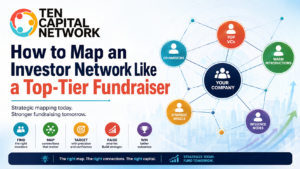
How to Map an Investor Network Like a Top-Tier Fundraiser

7 min read How to Map an Investor Network Like a Top-Tier Fundraiser Most founders approach fundraising backwards. They build a pitch deck first, then start scrambling to find investors. The best founders do the opposite: they build an investor network map before they ever ask for capital. Investor mapping is no longer optional. In today’s market, capital is concentrated in highly connected networks. The founders who understand those networks gain faster introductions, higher response rates, and better fundraising outcomes. [1] An investor network map is more than a spreadsheet of venture firms. It’s a strategic intelligence system that identifies: Which investors actively fund your sector Who co-invests together Which partners lead rounds Where warm introductions exist Which firms are deploying capital now How influence flows across your market The goal is simple: stop pitching random investors and start targeting connected capital. Step 1: Define Your “Ideal Investor Profile” Before researching firms, define exactly who should invest in your company. Your investor profile should include: Stage Pre-Seed Seed Series A Growth Sector Focus AI Fintech Healthcare Climate SaaS Deep Tech Geography U.S. Europe LATAM Southeast Asia Check Size Angel: $25k–$100k Seed VC: $250k–$2M Institutional: $2M+ Portfolio Alignment Similar companies Competitive adjacency Market thesis overlap This narrows your universe dramatically and prevents wasted meetings. Strategic investor mapping starts with precision, not volume. [3] Step 2: Build Your Initial Investor Universe Most founders stop after listing “top VCs.” That’s a mistake. You want layered investor categories: Tier 1: Dream investors Tier 2: Active specialists Tier 3: Strategic angels Tier 4: Syndicates and microfunds Tier 5: Corporate venture arms Use research platforms to identify active investors: Crunchbase AngelList PitchBook LinkedIn OpenVC Demo Day lists Podcast appearances Conference speaker rosters AngelList and Crunchbase are especially useful for filtering by stage, geography, and sector focus. [2] Your first pass should identify 50–100 relevant investors. Not all will matter equally. That’s where network analysis begins. Step 3: Identify Co-Investment Patterns The most important fundraising insight is this: Investors rarely invest alone. VCs operate in clusters. Some firms consistently co-invest together. Some angels follow specific lead investors. Some funds specialize in certain ecosystems or accelerators. Your job is to map those relationships. For every investor, track: Recent deals Co-investors in each round Lead vs follow behavior Repeat founder relationships Shared board members Accelerator affiliations You’ll quickly notice patterns. For example: Investor A always co-invests with Fund B Angel C appears in nearly every AI infrastructure seed round Fund D follows YC companies aggressively This transforms your fundraising strategy from “cold outreach” into network navigation. Network analysis helps startups identify the most connected and relevant capital pathways. [6] Step 4: Build a Warm Introduction Graph The highest-converting fundraising channel is still the warm introduction. But founders misunderstand warm intros. A warm intro is not “someone knows someone.” A strong warm intro comes from: Portfolio founders Repeat co-investors Trusted operators Existing LP relationships Shared accelerators Prior successful founders Create a relationship graph with three levels: Hot Connections People who know the investor personally and can directly recommend you. Warm Connections Second-degree relationships through founders, operators, or syndicates. Cold Connections No direct path, requiring content, traction, or outbound strategy. This becomes your investor access map. One warm introduction from a trusted founder can outperform 100 cold emails. Step 5: Score Investors by Probability Not all investors deserve equal attention. You should rank investors using a scoring model. Suggested scoring categories: Category Weight Sector Alignment 30% Stage Match 25% Recent Activity 20% Warm Intro Access 15% Geographic Fit 10% An investor actively funding your exact category within the past 12 months should rank far higher than a famous but inactive firm. The best founders focus on investors currently deploying capital, not just recognizable names. [4] Step 6: Track Investor Momentum Signals Investor mapping is dynamic. Funds evolve constantly. Some firms: Slow deployment Change thesis Raise new funds Shift stages Replace partners Pause investments You need momentum signals. Watch for: New fund announcements Hiring activity Recent lead rounds Increased conference appearances Podcast interviews Public market commentary Regulatory themes If a fund recently raised a new vehicle, deployment pressure rises significantly. That’s opportunity. Step 7: Map Influence Nodes Every ecosystem has hidden power centers. Sometimes the most influential person isn’t a VC partner. It may be: A super angel Accelerator MD Startup attorney Banker Founder with strong syndicate pull Scout program operator These people act as network bridges. One introduction from a highly connected node can unlock dozens of investor conversations. Mapping influence is often more important than mapping capital itself. Step 8: Organize Your Investor CRM At this point, you’re not building a contact list. You’re building a fundraising operating system. Your CRM should track: Investor name Fund Partner focus Last investment Intro path Relationship strength Follow-up timing Meeting notes Objections Interest level Next action Most founders lose fundraising momentum because they fail to systematize follow-up. Professional fundraising requires process discipline. Step 9: Create an Investor Narrative Strategy Every investor cluster responds to different narratives. Examples: AI investors care about infrastructure defensibility Climate investors focus on regulatory leverage Fintech investors care about distribution and compliance Deep tech investors prioritize technical moat Your investor map should include messaging angles for each segment. The best founders customize: Deck emphasis KPI framing Market sizing Technical depth Competitive positioning Fundraising is not one pitch. It’s a network-specific communication strategy. Step 10: Build Relationships Before You Need Capital The worst time to meet investors is when your runway is collapsing. The best founders start relationship-building 6–18 months before raising. This creates: Familiarity Credibility Progress tracking Trust accumulation Experts recommend identifying 20–30 aligned investors early and nurturing relationships over time. [5] Investors fund momentum they’ve observed, not just stories they’ve heard. Final Thoughts The modern fundraising market is not driven by access to information. Everyone has access to databases. The advantage now comes from understanding networks. Investor mapping gives founders: Better introductions Faster diligence Higher conversion rates Stronger syndicates More strategic investors The founders who win fundraising

Read More »

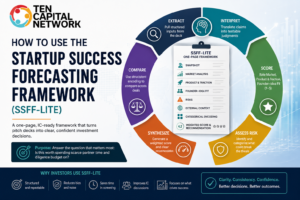
How to Use the Startup Success Forecasting Framework

7 min read How to Use the Startup Success Forecasting Framework Most early-stage investment decisions fail for two opposite reasons: we over-index on storytelling (and miss structural weaknesses), or we drown in details (and fail to make a crisp decision). The Startup Success Forecasting Framework (SSFF-Lite) is designed to do neither. It forces you to translate a pitch deck into a one-page, IC-ready judgment: what the company is, why it wins, what can break, and whether the bet is worth making right now. This article shows you how to use SSFF-Lite in practice, fast, repeatable, and decision-oriented, and without copying deck language or slipping into founder-friendly marketing. What SSFF-Lite is (and what it isn’t) SSFF-Lite is a disciplined compression tool. It converts slide content into a structured memo with: Three core scores (Market, Product & Traction, Founder–Idea Fit) A risk categorization table A categorical feature encoding (so you can compare companies consistently) A short external context check A weighted composite score and a clear recommendation It is not a full diligence report. It’s a first-pass investment committee artifact that answers: “Is this worth spending scarce partner time and diligence budget on?” The operating principle: interpret, don’t transcribe Pitch decks are persuasion documents. SSFF-Lite is an evaluation document. That means: Don’t copy slide phrases (“world-class,” “disrupting,” “only platform”). Translate them into testable claims. When data is missing, state assumptions explicitly—don’t fill gaps with optimism. If numbers are unclear, inflated, or inconsistent across slides, flag credibility risk. Your job is not to be “fair.” Your job is to be accurate under uncertainty. Step 1: Extract structured inputs (10–20 minutes) Before you score anything, build a clean fact base. SSFF-Lite starts with a structured extraction because bad evaluation often comes from messy inputs. Create a scratchpad and pull these items from the deck: Company identity Company Name Sector / Subsector (be specific—“Fintech” is not specific) Stage (inferable via traction, product maturity, fundraising ask) What it sells and to whom Business model (SaaS, marketplace, usage-based, services wrapper, etc.) Target customer (title + segment + buyer/user distinction) Revenue model (pricing units, contract size, payment terms) Problem and product Core problem (1–2 sentences, precise and painful) Product description (what it does; how it fits in workflow; why now) Traction metrics (only if provided; otherwise say “Not provided”) Revenue, growth rate, retention, CAC/LTV, pipeline, margins, engagement If metrics are missing but logos exist: treat that as distribution evidence, not PMF Team Founders & background: prior wins/losses, domain depth, technical capability, credibility signals Note team gaps (e.g., sales-led motion but no GTM leader) Market and competition TAM/SAM/SOM (if provided; sanity check definitions) Market growth claims and timing narrative Competitors named and implied (including “do nothing”) Differentiation and moat claims (translate into mechanisms) External context signals Industry shifts (regulatory change, platform shift, AI enabling wave, supply constraints) Funding environment referenced (if any) If anything is not explicitly stated: infer cautiously, label it as Assumption, and keep it falsifiable. Pro tip: separate your extraction into two columns: Deck claims Your interpretation This keeps you honest and prevents accidental marketing copy. Step 2: Write the SSFF-Lite memo (the one-page discipline) Now you convert inputs into judgment, section by section. 1) Snapshot (VC-scout layer) This is your fastest summary of the company’s shape: Sector classification Stage assessment (inferred) Business model clarity (clear / semi-clear / unclear) Core problem (precise, no fluff) Outcome delivered (measurable if possible) Think of this as the “triage paragraph” an IC member reads first. If you can’t write it cleanly, you don’t understand the business yet. Scoring: how to assign 1–5 without fooling yourself SSFF-Lite asks you to score Market, Product & Traction, and Founder–Idea Fit from 1 to 5. The point isn’t false precision—it’s consistency. 2) Market Analysis (Score 1–5) Evaluate four things: Market size: niche / mid-size / large / massive Growth phase: early / inflecting / accelerating / mature Competitive intensity: low / moderate / high Structural moat: none / emerging / defensible Write one analytical paragraph that answers: Is this a big outcome space or a constrained pond? Is the wave growing or stagnant? Are there entrenched incumbents or commodity competition? Is there a structural advantage available (data, network effects, regulation, switching costs)? Scoring guidance 1: structurally limited, hard ceiling, or brutal incumbent dominance 3: credible market, but competitive and not structurally advantaged 5: large + fast-growing + a real path to structural advantage Avoid giving a 5 just because TAM is large. TAM slides are often aspirational. 3) Product & Traction (Score 1–5) Evaluate: Value proposition clarity (can you explain it in one sentence?) Product maturity (MVP / early revenue / scaling / mature) Evidence of PMF (none / early signals / retention proof / expansion proof) Execution velocity (shipping, sales cycle learning, iteration cadence) Use actual metrics if available. If not, be explicit: “Traction metrics not provided; evidence limited to logos and pilot claims.” Scoring guidance 1: vague product, no proof, long path to adoption 3: functioning product + early demand signals, but PMF unproven 5: retention/expansion proof and clear scaling motion 4) Founder–Idea Fit (FIFS) (Score 1–5) Assess: Domain alignment (lived pain or deep operator experience) Insight advantage (why this team sees the wedge others don’t) Technical/operational credibility (can they build and ship?) Commitment signals (time, focus, sacrifices) Team completeness (or clear plan to fill gaps) Scoring guidance 1: weak alignment, generic story 3: relevant experience, credible builders 5: deep, unfair advantage (domain network + technical edge + insight) 5) Risk categorization table (make risks legible) Create a table with: Market Risk Product Risk Execution Risk Capital Intensity Regulatory Risk Label each Low/Medium/High and add a one-line why. This forces you to distinguish between: “We don’t like it” (vibes) “It can break here” (mechanism) Example (in plain language): Execution risk: High — enterprise sales motion with no senior GTM leader; long cycles could stall learning. 6) Structured feature encoding (so you can compare companies) This is a categorical summary with no narrative: Market Size: Small / Mid / Large Market

Read More »

5 min read Building an Angel Network: Lessons from Launching Three Successful Groups Angel investing can be powerful , but it’s even more powerful when done together. Over the past two decades, I’ve had the opportunity to help launch three angel networks: Central Texas Angel Network (CTAN), Baylor Angel Network, and Wilco Angel Network. Each started with a simple idea: bring serious investors together to see better deals, share diligence, and deploy capital more effectively. If you’re considering joining a syndicate, or starting your own angel group — here’s what I’ve learned about why networks work, how to build them, and where many groups go wrong. Why Angel Networks Matter More Than Ever Startup investing has changed. Access to deals has widened. Valuations have compressed and expanded in cycles. Information flows faster. But one thing hasn’t changed: early-stage investing is risky and relationship-driven. A well-run angel network reduces risk, improves diligence quality, and increases access to proprietary deal flow. When structured correctly, it becomes more than a club — it becomes an intelligence network. 5 Key Takeaways from Building Angel Networks   1. Syndication Reduces Risk Without Reducing Upside The biggest misconception about angel groups is that they dilute returns. In reality, they often improve them. By pooling capital, investors can diversify across more deals instead of concentrating too heavily in one or two startups. Shared diligence reduces blind spots. Stronger follow-on capacity helps winners survive. Syndication spreads risk while preserving access to upside. 2. Deal Flow Improves Dramatically in a Network Quality entrepreneurs don’t pitch everyone — they pitch where capital aggregates. When investors operate individually, they see fragmented opportunities. When they operate as a group, founders take notice. A credible angel network becomes a magnet for stronger deals, co-investment opportunities, and venture partnerships. Scale attracts quality. 3. Shared Diligence Raises the Bar No single angel is an expert in everything. But collectively, the room often is. In every network I helped build, the turning point was when members began leading diligence in their domain expertise — finance, product, regulatory, sales, operations. This distributed model improves decision-making and reduces emotional investing. The result: better questions, clearer risk assessment, and stronger conviction when writing checks. 4. Structure Determines Longevity Angel networks fail when they lack structure. Clear membership criteria, defined investment processes, regular deal cadence, and disciplined screening matter. Informality works early — but governance sustains growth. The groups that endure are those that balance flexibility with operational rigor. Investing is serious business. The infrastructure must reflect that. 5. Culture Drives Participation Capital joins structure. Investors stay for culture. Angel networks thrive when members feel respected, informed, and engaged. Education sessions, transparent communication, and clear alignment on strategy keep investors active. Without participation, networks stagnate. With strong culture, they compound. Why Investors Join Angel Networks When investors consider joining a group — or launching one — their motivations usually fall into five categories: Diversification without losing control Access to stronger deal flow Shared diligence to reduce blind spots Learning from experienced peers Community with like-minded capital allocators Angel investing can be lonely. Networks turn it into a disciplined team sport. The Hidden Advantage: Intelligence Compounding The most overlooked benefit of angel networks isn’t just pooled capital — it’s pooled insight. Each deal reviewed builds pattern recognition. Each diligence cycle sharpens instincts. Over time, the group develops a collective memory that dramatically improves screening efficiency and risk calibration. That compounding intelligence becomes a competitive advantage. Starting Your Own Angel Network If you’re thinking about launching a group, focus on three fundamentals: Start with a core of committed investors, not just interested ones. Define your thesis early — geography, stage, sector, or values alignment. Build process before volume — screening, diligence, voting, and follow-on strategy. Growth comes naturally when trust and process are in place. Final Thought Angel networks aren’t just about writing checks — they’re about building infrastructure for smarter capital deployment. Syndication reduces risk. Shared diligence improves decision-making. Strong culture sustains momentum. If you’re an investor considering joining a network — or starting one — now is one of the most compelling times to do it. The market rewards disciplined, collaborative capital. If this perspective resonates, subscribe for more insights on building investor ecosystems, scaling angel groups, and deploying capital with intelligence. And if you’re exploring syndication strategies or launching a network of your own, I’d love to hear what you’re building.

Read More »

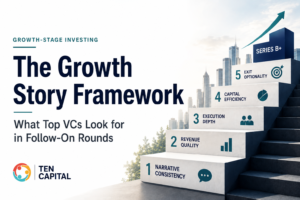
The Growth Story Framework: What Top VCs Look for in Follow-On Rounds

7 min read The Growth Story Framework: What Top VCs Look for in Follow-On Rounds Early-stage investors often focus on vision, team, and market potential. But when it comes to follow-on rounds—Series A, B, and beyond—the evaluation criteria shifts dramatically. Later-stage investors are not buying possibility; they’re underwriting performance, scalability, and durability. Understanding how growth-stage VCs evaluate companies doesn’t just help founders prepare for their next round—it helps angels and seed investors make smarter initial bets and support portfolio companies more effectively. It also sharpens exit strategy thinking from day one. Here’s the framework top VCs use when deciding whether to lean in—or walk away. 1. Narrative Consistency: Is the Growth Story Coherent? Growth-stage investors look for a clear, consistent narrative from inception to scale. The story must connect early traction to a larger strategic opportunity: Why this market? Why this model? Why now? If the company’s direction has pivoted multiple times without a compelling throughline, it raises questions about strategic clarity. The best companies demonstrate evolution—not randomness. Every stage builds logically on the last. Takeaway: Early investors should help founders craft a scalable narrative from day one. A company’s “Series A story” is often seeded in its pre-seed pitch. 2. Revenue Quality: Not Just Growth, but Durable Growth At the seed stage, 3x–5x growth can compensate for messy fundamentals. In follow-on rounds, that’s no longer enough. Later-stage VCs dissect revenue composition with precision: Customer concentration Retention cohorts Net revenue retention (NRR) Expansion revenue Gross margins Sales efficiency They want to know: Is this growth repeatable? Predictable? Profitable at scale? A company growing 100% year-over-year with strong retention and improving unit economics is fundamentally different from one buying growth through heavy discounting and churn. Takeaway: Angels should pay attention to revenue quality early. Supporting founders in building strong reporting habits and disciplined GTM processes pays off later. 3. Execution Depth: Can This Team Operate at Scale? Early-stage investing is often a bet on raw talent and founder grit. Later-stage investing evaluates operational maturity. Growth investors assess: Leadership bench strength Functional expertise (sales, finance, operations) Hiring velocity and retention Board governance KPI visibility and forecasting discipline A strong founder is essential—but insufficient. VCs want to see a management team that can run a multi-million (or multi-hundred-million) revenue engine. Takeaway: Smart early investors encourage founders to upgrade talent proactively—not reactively. Scaling companies require scaling leadership. 4. Capital Efficiency: How Much Fuel to Create the Next Milestone? Follow-on investors aren’t just asking, How big can this get? They’re asking, How efficiently can it get there? Burn multiple, CAC payback, and runway discipline matter. Even in bullish markets, growth-stage VCs prefer companies that demonstrate thoughtful capital allocation. In tighter markets, this becomes non-negotiable. Companies that can articulate exactly how $20M translates into defined ARR, margin expansion, or market share gains signal strategic maturity. Takeaway: Early investors should help founders treat capital as strategic leverage, not validation. Efficient companies have more financing options—and stronger negotiating power. 5. Exit Optionality: Is There a Clear Strategic Path? By the time a company reaches later-stage funding, investors are modeling outcomes. Who are the logical acquirers? What valuation benchmarks are realistic? Is there a credible IPO path? How defensible is the competitive moat? Follow-on investors want to see multiple exit pathways, not a single aspirational scenario. They’re underwriting return profiles based on risk-adjusted probability. For angels, this perspective is critical. A company that looks exciting at seed may struggle to attract growth capital if it lacks a clear path to liquidity. Takeaway: Exit strategy thinking shouldn’t start at Series C. It should inform market selection and business model design from the beginning. Why This Framework Matters for Early Investors Too often, early investors think in isolation: Is this a good seed deal? The better question is: Will this be a good Series A or B company? When angels understand how growth-stage VCs evaluate opportunities, they can: Select startups more likely to secure follow-on capital Coach founders toward scalable metrics Reduce dilution risk Increase probability of meaningful exits In other words, they invest with the end in mind. Building With the Future Round in Mind The most successful companies don’t “prepare for a Series A” at the last minute. They build in alignment with what growth capital demands from the start. As an investor or founder, ask yourself: Are we building durable growth—or temporary momentum? Are our metrics institutional-grade? Is our narrative scaling with our traction? Are we designing for exit optionality? These are not late-stage questions. They are foundational ones. Final Thought The Growth Story Framework is more than a fundraising checklist—it’s a strategic lens. Whether you’re writing your first check or preparing your next round, understanding how top VCs think will elevate your decisions. If you found this helpful, subscribe for deeper insights on startup finance, growth strategy, and investor intelligence. And if you’re supporting portfolio companies today, share this framework with them—it may shape their next round more than you think.

Read More »

The Importance of Signaling in a Pitchdeck

7 min read The Importance of Signaling in a Pitchdeck   Why investors often fund what your deck implies—not just what it says. Most founders believe a pitch deck exists to communicate information. Investors know a pitch deck exists to communicate signals. This distinction is one of the most important lessons an entrepreneur can learn during a fundraising process. While founders spend countless hours perfecting market slides, refining financial projections, and debating TAM calculations, sophisticated investors are often evaluating something entirely different: what the deck signals about the company, the founder, and the probability of future success. Fundraising is fundamentally an exercise in reducing uncertainty. Investors are asked to place capital into businesses that have little operating history, incomplete data, and uncertain outcomes. Because direct evidence is limited, investors rely heavily on signals to infer quality. The best pitch decks understand this reality and are intentionally designed to send strong signals at every stage of the presentation. What Is Signaling? In venture capital, signaling refers to information that communicates quality, credibility, momentum, or future potential beyond the literal facts being presented. A signal helps investors answer questions such as: Is this founder exceptional? Is this market real? Are customers validating the product? Are other sophisticated people involved? Is momentum accelerating? Will this company attract future investors? Every slide in a pitch deck either strengthens or weakens these perceptions. The most successful fundraising decks don’t simply explain a business. They create confidence. Investors Invest in Confidence Consider two companies generating identical revenue. Company A reports $500,000 in annual recurring revenue. Company B reports $500,000 in annual recurring revenue but also shows: 20% month-over-month growth Enterprise customers A former Google executive as advisor A respected lead investor Multiple inbound partnership discussions The financial result is identical. The signaling value is dramatically different. The second company appears less risky because multiple external parties are already validating the opportunity. Investors are constantly looking for evidence that others have independently reached the same positive conclusion. Strong signaling reduces perceived risk. Reduced risk increases valuation. Founder Signaling Matters More Than Most Founders Realize Early-stage investors frequently state they invest in teams more than products. This is another way of saying they invest in founder signals. Before meaningful revenue exists, investors evaluate indicators such as: Prior Success Previous exits, startup experience, industry expertise, patents, publications, and leadership roles all function as credibility signals. A founder who previously built and sold a company sends a different signal than a first-time entrepreneur. That doesn’t mean first-time founders cannot raise capital. It means they must compensate with other signals. Domain Expertise Founders who have spent years inside the problem demonstrate insight that outsiders often lack. For example: A healthcare startup founded by a physician signals deeper understanding than one founded by someone who simply identified a healthcare market opportunity. Investors view lived experience as evidence that the team understands customer pain points, industry dynamics, and regulatory challenges. Founder-Market Fit One of the strongest signals in venture investing is founder-market fit. Investors want to see a compelling reason why this specific team is uniquely positioned to win. The strongest founder slides answer: “Why are you the people to solve this problem?” Not: “Why is this problem important?” Customer Validation Is a Signal, Not Just a Metric Founders often view traction slides as numerical reporting. Investors view them as validation signals. For example: Ten pilot customers may be more impressive than one hundred free users. Why? Because pilots require commitment. Commitment signals belief. Belief signals value. Similarly, enterprise customers often carry stronger signaling power than consumer users because enterprise buying decisions involve more scrutiny. A Fortune 500 customer effectively says: “We evaluated alternatives and selected this solution.” That endorsement carries substantial weight. When building traction slides, founders should ask: “What does this metric signal about customer conviction?” Not simply: “What number is largest?” The Power of Social Proof Social proof is one of the strongest signaling mechanisms in fundraising. Investors routinely ask themselves: “What do other smart people think about this opportunity?” Every credible third-party validation strengthens the answer. Examples include: Existing Investors Well-known angel investors, venture funds, or industry leaders create powerful signals. Investors understand that sophisticated capital providers conduct diligence. When respected investors participate, they effectively lend credibility to the company. Strategic Advisors Advisors can provide meaningful signaling value when they are genuinely involved and relevant. An advisor with direct industry expertise often signals: Market access Industry understanding Operational support Future partnership opportunities However, investors quickly recognize decorative advisors with minimal engagement. Authenticity matters. Partnerships Meaningful commercial partnerships demonstrate market validation. They signal that established organizations believe the startup provides value. Partnership announcements often generate more investor interest because they imply future distribution opportunities and reduced go-to-market risk. Design Quality Is a Signal Many founders underestimate the signaling value of deck design. Investors notice. A poorly designed deck may unintentionally communicate: Lack of attention to detail Weak communication skills Resource constraints Inexperience Conversely, a clean, professional deck signals discipline, preparation, and competence. Importantly, investors are not looking for artistic excellence. They are looking for clarity. A simple, well-structured deck often outperforms a visually impressive but confusing presentation. The signal investors want is operational excellence. Not graphic design talent. Momentum Is One of the Most Powerful Signals in Venture Capital Nothing attracts investors like acceleration. Momentum suggests that future performance may exceed historical performance. Examples include: Revenue growth User growth Customer acquisition efficiency Product adoption Hiring progress Pipeline expansion A company growing from $10,000 to $50,000 monthly revenue in six months often appears more attractive than a company generating $500,000 annually with flat growth. Investors are buying the future. Momentum helps them visualize that future. The best fundraising decks showcase acceleration wherever possible. Not just absolute scale. Scarcity Creates Signaling Effects Fundraising itself generates signals. This is why experienced founders carefully manage their fundraising process. When investors believe: Multiple firms are engaged Demand exceeds allocation The round is progressing quickly They often perceive the opportunity as more attractive. Scarcity functions

Read More »

Red Flags in Startup Pitches: What Makes Experienced Investors Pass

5 min read    Red Flags in Startup Pitches: What Makes Experienced Investors Pass Every investor loves the thrill of discovering a breakout company. But after a decade of reviewing thousands of startup pitches, I can tell you this: avoiding bad investments is just as important, often more important, than finding the next unicorn. Pattern recognition isn’t built by the wins alone; it’s forged by seeing the same mistakes repeat themselves over and over. In this piece, I’ll walk through the most common red flags that cause experienced investors to quietly, or not so quietly, pass on a deal. These aren’t theoretical concerns or academic nitpicks. They’re real-world signals that something beneath the surface isn’t ready, resilient, or investable. Why Red Flags Matter More Than Hype Great storytelling can open doors, but fundamentals determine whether they stay open. Investors who have been burned before learn to listen less to the sizzle and more to the structure underneath. Red flags are rarely fatal on their own—but clusters of them almost always are. The goal isn’t perfection. It’s coherence, honesty, and evidence of thoughtful leadership under pressure. Five Red Flags That Make Investors Walk Away 1. The Founder Can’t Clearly Explain the Problem If a founder struggles to articulate the problem they’re solving in plain language, investors immediately question whether the problem is real—or merely convenient. Complexity isn’t a sign of sophistication; clarity is. When the pain point sounds abstract, generic, or borrowed from a trend report, conviction erodes fast. Strong founders can explain the problem simply because they’ve lived it, studied it deeply, or watched it break real systems. If the “why now” is missing or fuzzy, it’s usually a pass. 2. The Market Size Is Inflated or Vague “TAM is $100 billion” has become background noise. What investors want to see is how this company realistically captures a meaningful slice of a market, not how large the theoretical ceiling might be. Overly inflated market sizing signals either naivety or intentional misdirection. Experienced investors look for bottoms-up thinking: specific customers, real pricing, and believable adoption paths. When market math feels like a PowerPoint exercise instead of a business reality, confidence drops quickly. 3. Financials That Don’t Match the Story One of the fastest ways to lose investor trust is internal inconsistency. If the pitch narrative says one thing and the financial model says another, investors assume the model—or the story—can’t be trusted. Optimism is expected; disconnects are not. Revenue projections without operational detail, cost structures that defy logic, or growth curves that ignore constraints all raise alarms. Investors aren’t looking for perfect forecasts—they’re looking for disciplined thinking. 4. Defensive or Evasive Responses to Tough Questions Every serious pitch includes hard questions. The red flag isn’t not knowing the answer—it’s how the founder reacts when challenged. Defensiveness, deflection, or overconfidence suggests fragility under pressure. Great founders treat questions as collaboration, not confrontation. They acknowledge risks, explain tradeoffs, and show how they’re learning in real time. When ego blocks insight, investors take notice—and step back. 5. No Evidence of Learning or Adaptation Startups are defined by uncertainty. Founders who present their strategy as fixed, flawless, or immune to change signal inexperience. Investors want to see evidence of iteration: pivots informed by data, customer feedback shaping product decisions, and lessons learned from things that didn’t work. A pitch that sounds too polished, too static, or too certain often hides a lack of real-world testing. Growth-stage thinking starts with humility, not certainty. What Experienced Investors Are Really Screening For Behind every red flag is a deeper question investors are asking themselves: Can I trust this team with my capital when things go wrong? Because they will go wrong, markets shift, customers surprise you, and capital tightens. Pattern recognition doesn’t make investors cynical; it makes them selective. The best pitches don’t eliminate risk, they demonstrate awareness, judgment, and resilience in the face of it. A Final Thought Learning what not to invest in is one of the most valuable skills an investor can develop. The same is true for founders: understanding how your pitch may be perceived can dramatically improve both your fundraising outcomes and your strategic thinking. If this resonated, I’d love to hear your thoughts. Drop a comment with the toughest investor question you’ve faced—or the biggest red flag you’ve learned to avoid. And if you want more insights drawn from real-world deal review and investor pattern recognition, consider subscribing to stay in the loop.  

Read More »

Site Map

Scroll to Top